Kellyho kritérium a ruleta
Kellyho kritérium hovorí hráčovi, ktorý má výhodu, koľko staviť. Pre ruletu dáva jasnú odpoveď: nič.

Kellyho stávka = výhoda / pomer výplaty. Pri zápornej výhode vzorec vráti záporný podiel, čo znamená nestaviť. Kritérium je napriek tomu užitočné na pochopenie, prečo hráči na vychýlené kolesá dimenzovali stávky tak, ako to robili, a prečo všetci ostatní majú stávky dimenzovať podľa rozpočtu.
Kritérium
John Kelly (1956) asked how a gambler with a known edge should size bets to maximize long-run growth of the bankrollpeniazeBankrollCelková suma vyhradená na hru. Správa bankrollu znamená rozhodnúť, koľko z nej riskovať na jednu stávku a na jedno sedenie.Čítať celé →. The answer, for a bet paying b to 1 with win probabilitymatematikaPravdepodobnosťMiera možnosti, že nastane určitý výsledok, od 0 do 1 alebo od 0% do 100%. Jedno číslo: 1/37 = 2,70%.Čítať celé → p and loss probability q = 1 − p, is to stake the fraction f* = (bp − q) / b of the bankroll. Positive f* means bet that fraction; zero or negative means do not bet. Kelly worked at Bell Labs, and his paper, “A new interpretation of information rate”, set the problem in Claude Shannon’s theory of information: a gambler who gets tips over a noisy line, at fair odds, can grow the bankroll at best at the rate the line carries information. This is a growth objective under a probability model, not a promise to finish ahead after a particular number of bets. A spending limit, finite deadline or payoutpeniazeVýplataTo, čo výherná stávka prinesie, uvádzané ako „X ku 1“ navyše k vrátenej stávke.Čítať celé → cap changes the decision problem.
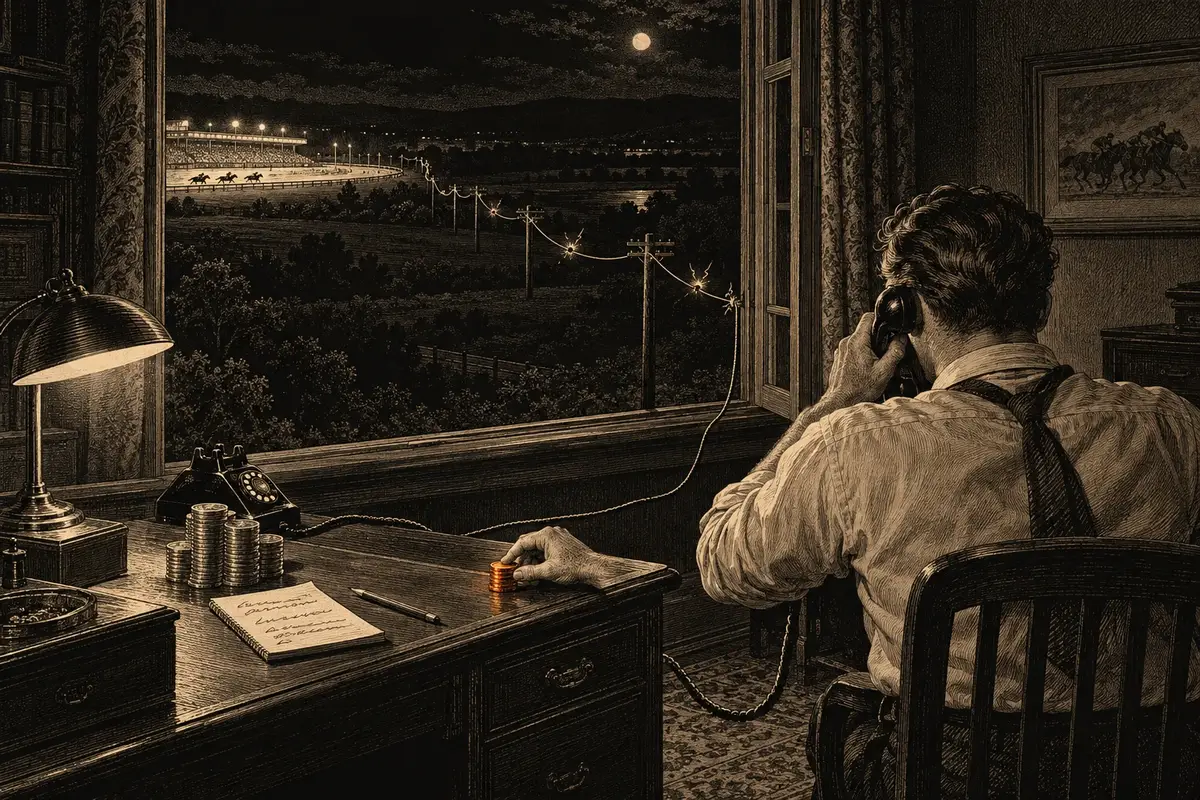
Stávkovanie podľa Kellyho v rulete
For redstávkaČervenáStávka na jednoduchú šancu na 18 červených čísel. Po francúzsky: rouge.Čítať celé →: b = 1, p = 18/37, q = 19/37; f* = (18/37 − 19/37)/1 = −1/37. For a straight upstávkaPlné čísloJediné číslo, vypláca 35:1.Čítať celé →: b = 35, p = 1/37, q = 36/37; f* = (35/37 − 36/37)/35 = −1/1295. Every standard bet gives a negative Kelly fraction, because every bet has a negative edge, and the growth-optimal stake is zero. Kelly betting on roulette is a formal way of saying what the house-edge page says: no positive stake maximizes expected logarithmic growth when the bet has negative expectation. A particular session can still end in profit. La partagepravidloLa partageFrancúzske pravidlo: keď padne nula, vráti sa polovica stávky na jednoduchú šancu. Pri týchto stávkach znižuje výhodu kasína na polovicu, na 1,35%.Čítať celé → needs a separate three-outcome calculation: a win, a full loss or a half-loss on zerokolesoNulaJediná zelená priehradka, ktorú nepokrýva žiadna stávka na jednoduchú šancu, tucet ani stĺpec; zdroj výhody kasína. Tiež: jednoduchá nula, 0.Čítať celé →. Its expected log growth also falls as the stake increases from zero.
| stávka | b | p | f* = (bp − q)/b | význam |
|---|---|---|---|---|
| červená, európska | 1 | 18/37 | −0,027 | nestaviť |
| červená, la partage | tri výsledky | 18/37 výhra; 1/37 strata polovice | binárny vzorec neplatí | rastovo optimálna stávka 0% |
| plné číslo | 35 | 1/37 | −0,00077 | nestaviť |
| plné číslo na priehradke 1/30 (vychýlená) | 35 | 1/30 | +0,0057 | staviť 0,57% bankrollu |
| plné číslo na priehradke 1/25 | 35 | 1/25 | +0,0126 | staviť 1,26% bankrollu |
Kde Kelly naozaj platil
Suppose a pocketvybaveniePriehradkaJeden z 37 očíslovaných oddielov na rotore. Tiež: slot, cup.Čítať celé → really has a stable, known probability of 1 in 30 and pays 35 to 1. The Kelly fraction is 0.57%: about $57 from a $10,000 bankroll. Under independent spinsmatematikaNezávislé spinyKaždý spin má rovnaké pravdepodobnosti bez ohľadu na históriu. Základ každého výpočtu na tejto stránke.Čítať celé → and exact fractional staking, the geometric growth factor over 1,000 spins is about 1.7. Expected bankroll grows faster because rare large wins pull up the average. These are model calculations, not evidence that any named historical player used Kelly or achieved this result.
Typický a priemerný
The gap between the typical bankroll and the average one is wide. Take a pocket that hits 1 time in 25, a hypothetical edge of 44% per unitpeniazeJednotkaZákladná stávka, v ktorej systém alebo hráč počíta. Progresie sa opisujú v jednotkách, aby platili pri akomkoľvek stole.Čítať celé → staked. Kelly stakes 1.26% of the bankroll on it. After 1,000 spins the typical bankroll has grown about 11.5 times, while the average, pulled up by a few very lucky runs, has grown about 249 times. Betting more than Kelly raises the average and lowers the typical result: at twice the Kelly stake the typical bankroll only doubles, and by two and a half times the Kelly stake it shrinks, although every bet still carries a 44% edge. In this example, half-Kelly retains about 78% of the expected log growth. This fraction depends on the probabilities and payout.
| stávka, podiel Kellyho | stávka, % bankrollu | typický bankroll po 1 000 spinoch |
|---|---|---|
| ½ | 0,63% | × 6,7 |
| 1 | 1,26% | × 11,5 |
| 1½ | 1,89% | × 7,4 |
| 2 | 2,51% | × 2,2 |
| 2½ | 3,14% | × 0,38 |
| 3 | 3,77% | × 0,04 |
Keď je výhoda iba odhad
Kelly uses the true probabilities, but a player usually has only estimates. Selecting the busiest pocket from a past record creates a selection problem: even a fair wheel has a busiest pocket. Its observed rate can overstate its future probability. Choosing the stake from that same record compounds the error. An independent follow-up sample helps test a proposed bias (see How to Detect Roulette Wheel Bias). Reducing the calculated fraction reduces exposure, but cannot turn a false edge into a real one.
Ľudia s výhodou
Haghani and Dewey (2016) studied 61 participants given $25 and 30 minutes to bet on a simulated coin with a disclosed 60% chance of heads. The payout cap was $250; its value was revealed when a proposed winning bet would reach it. Their reported 21% success category included balances of at least $200, while the 28% “bust” category meant less than $2, not necessarily zero. Eighteen participants bet their entire balance on one flip. The uncapped Kelly fraction is 20%, but the cap and deadline change the optimization problem. The experiment illustrates how stake choices matter even with a known advantage; it does not establish one best strategy for every objective.
Čo použiť namiesto toho
Bez výhody je výška stávky otázkou rozpočtu, nie rastu: stávka = to, čo ste ochotní minúť na spin, odvodené z hodinového rozpočtu a tempa stola (stránka Správa bankrollu). Prínos Kellyho pre bežného hráča je jasnosť jeho odpovede: nula. Všetko, čo stavíte nad nulu, je cena za hru, ktorú si volíte vy, a neoptimalizuje ju žiadny vzorec.
Poznámka k zlomkovému Kellymu a „money managementu“
Betting a fixed percentage of the current bankroll is proportional staking: the stake rises after wins and falls after losses. Flat bettingstratégiaRovnaké stávkyStávkovanie rovnakej sumy v každom spine. Základ, s ktorým sa porovnáva každá progresia.Čítať celé → instead keeps the cash stake fixed. Neither creates an edge on ordinary roulette. With infinitely divisible stakes and a fraction below 100%, proportional staking never reaches exactly zero in finitely many losses, but the balance can become arbitrarily small. Real table minimums can prevent further play much sooner. The growth-optimal fraction remains zero.
Vzorec
Otázky
Only when the actual probabilities, payouts and conditions give a credible positive advantage. Standard bets on an unbiased wheel have no such advantage.
Using half the calculated fraction reduces exposure to errors in the estimated edge. The familiar three-quarters-growth rule is an approximation for small advantages, not a universal identity. It does not protect against an edge that does not exist.
Nie. Kelly optimalizuje rast, keď výhoda existuje. Správa bankrollu kontroluje míňanie, keď žiadna nie je.
Matematika pre radosť
Skúste ich najprv sami. Každé riešenie je skryté; rozbaľte ho, keď budete pripravení.
Suppose a hypothetical bet on one number has a known 44% edge under standard payoutspeniazeVýplataTo, čo výherná stávka prinesie, uvádzané ako „X ku 1“ navyše k vrátenej stávke.Čítať celé → and independent spinsmatematikaNezávislé spinyKaždý spin má rovnaké pravdepodobnosti bez ohľadu na históriu. Základ každého výpočtu na tejto stránke.Čítať celé →. Kelly gives a 1.26% bankrollpeniazeBankrollCelková suma vyhradená na hru. Správa bankrollu znamená rozhodnúť, koľko z nej riskovať na jednu stávku a na jedno sedenie.Čítať celé → fraction. What if the same 44% edge came on one bet spread over five neighboring numbers?
Zobraziť riešenie
Odpoveď Kelly potom odporúča 7,1% bankrollu a bankroll rastie takmer šesťkrát rýchlejšie: za 1 000 stávok asi 1,25-miliónkrát, oproti asi 11,5-krát.
A straight upstávkaPlné čísloJediné číslo, vypláca 35:1.Čítať celé → with a 44% edge wins with chance 0.04, since 36 × 0.04 = 1.44. Kelly’s stake is the edge divided by the odds: 0.44/35 = 1.26%. The typical growth per bet is 0.04 × ln(1 + 35 × 0.0126) + 0.96 × ln(1 − 0.0126) ≈ 0.00244, so 1,000 bets multiply the bankroll by about e^2.44 ≈ 11.5.
Spread one stake over five numbers and the bet wins with chance 0.20 and pays 36/5 for 1, that is 6.2 to 1: still a 44% edge, since 0.2 × 7.2 = 1.44. Kelly’s stake becomes 0.44/6.2 = 7.10%, and the growth per bet 0.01404, about 5.75 times as much. Over 1,000 bets that is e^14.04, about 1.25 million.
The edge is the same; the swings are smaller. A bet that wins one time in five has a larger growth-optimal fraction in this model, although losses can still reduce the bankroll severely. This comparison assumes the same known edge for both bets; actual predictions need independent evidence.
Assume two numbers are adjacent on the betting layoutvybavenieStávkové poleVytlačená stávková mriežka na stole. Tiež: stôl, plátno, súkno.Čítať celé → and each has a stable, known probabilitymatematikaPravdepodobnosťMiera možnosti, že nastane určitý výsledok, od 0 do 1 alebo od 0% do 100%. Jedno číslo: 1/37 = 2,70%.Čítať celé → of 1 in 25 on independent spins. Compare a splitstávkaDvojicaDve susedné čísla, vypláca 17:1.Čítať celé → between them at 17 to 1 with equal straight-up stakes on the two numbers. How much does Kelly say, and how fast does the bankroll grow compared with one such pocketvybaveniePriehradkaJeden z 37 očíslovaných oddielov na rotore. Tiež: slot, cup.Čítať celé →?
Zobraziť riešenie
Odpoveď Nezáleží na tom: 2,59% bankrollu na dvojicu alebo 1,29% na každé číslo. Typický bankroll vzrastie za 1 000 spinov asi 155-krát, oproti 11,5-krát s jednou priehradkou.
The split wins with probability 2/25 = 0.08 and pays 17 to 1, so it returns 18 × 0.08 = 1.44 per unitpeniazeJednotkaZákladná stávka, v ktorej systém alebo hráč počíta. Progresie sa opisujú v jednotkách, aby platili pri akomkoľvek stole.Čítať celé → staked: an edge of 44%, the same as one biased pocket. Kelly’s stake is the edge divided by the odds: 0.44/17 = 2.59%.
Two straight-up bets of 1.29% each give exactly the same results. When either number comes up, one chippeniazeŽetónZnámka predstavujúca pevnú sumu, ktorá sa kladie na stávkové pole, aby vznikla stávka. Tiež: cheque.Čítať celé → wins 35 to 1 and the other is lost, a net of 34 × 1.29% = 44% of the bankroll, as the split pays; when neither does, both are lost.
The growth per spin is 0.00505, against 0.00244 for one pocket, so over 1,000 spins the typical bankroll grows e^5.046 ≈ 155 times rather than e^2.44 ≈ 11.5 times. The geometric growth factor is larger because the combined bet wins more often at the same 44% edge. It is a model result, not a guaranteed bankroll.
Na odľahčenie
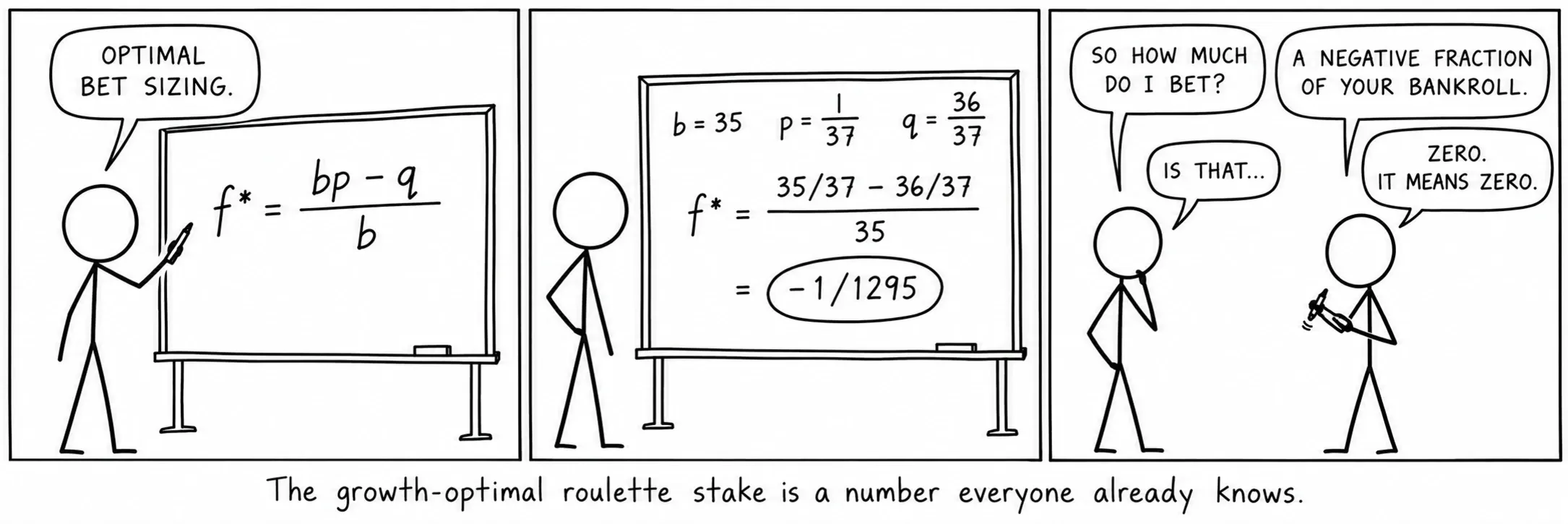
Stávka na ruletu optimálna pre rast je číslo, ktoré už všetci poznajú.
Zdroje
- Kelly, J. L. „A new interpretation of information rate.“
- Breiman, L. „Optimal gambling systems for favorable games.“
- Thorp, E. O. „Optimal gambling systems for favorable games.“
- Thorp, E. O. The Mathematics of Gambling.
- Epstein, R. A. The Theory of Gambling and Statistical Logic, 2nd ed.
- Taylor, D. G. Games, Gambling, and Probability: An Introduction to Mathematics, 2nd ed.
- Ethier, S. N. The Doctrine of Chances: Probabilistic Aspects of Gambling.
- Haghani, V. & Dewey, R. „Rational decision-making under uncertainty: observed betting patterns on a biased coin.“